Chemical Process Development: From Laboratory Discovery to Reliable Manufacturing
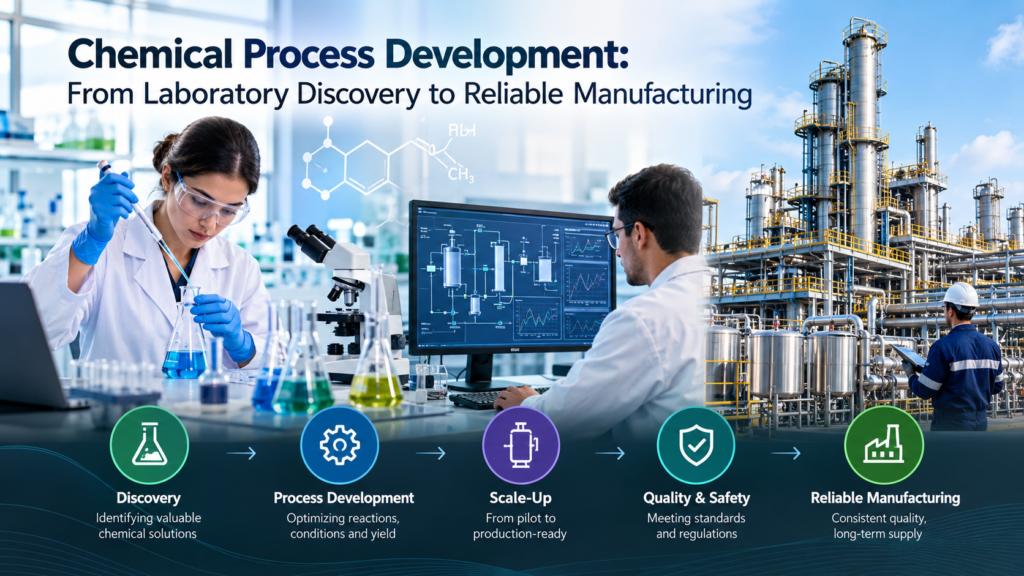
A chemical reaction may deliver promising results in a small laboratory experiment yet behave very differently when performed at a larger scale. Heat transfer, mixing efficiency, impurity formation, and material handling can all influence the outcome.
Chemical Process Development addresses these challenges by transforming early chemical methods into controlled, reproducible manufacturing processes.
The objective is not simply to increase reaction volume. It is to understand the chemistry sufficiently to maintain quality, improve robustness, and support practical manufacturing conditions.
Starting With a Clear Understanding of the Chemistry
Successful Chemical Process Development begins by examining the fundamental reaction pathway.
Chemists evaluate reaction mechanisms, starting material characteristics, reagent behavior, and potential competing reactions.
Understanding these factors helps identify conditions that influence conversion, selectivity, and impurity generation.
Evaluating Reaction Conditions
Temperature, concentration, reaction time, and mixing conditions can substantially affect chemical outcomes.
Systematic experimentation helps determine how changes in these variables influence reaction performance.
For example, increasing temperature may improve reaction speed while simultaneously encouraging unwanted side reactions.
Chemical Process Development evaluates such tradeoffs to identify operating conditions that support consistent results.
Why Laboratory Success Does Not Guarantee Scale-Up Success
Small-scale experiments often benefit from efficient mixing and rapid temperature adjustment.
Larger manufacturing equipment introduces different physical conditions.
Heat may accumulate in certain regions, mixing patterns may change, and material addition times may become longer.
These differences can alter reaction behavior.
Understanding Heat Transfer and Reaction Safety
Some chemical reactions release significant amounts of heat.
Without adequate thermal control, larger operations may experience unexpected temperature increases.
Chemical Process Development includes assessing thermal behavior and identifying appropriate operating safeguards.
Reaction calorimetry, hazard evaluation, and controlled addition strategies can contribute to safer manufacturing conditions.
Managing Mixing and Mass Transfer
Mixing influences how quickly materials interact.
Poor mixing may create local concentration differences that affect reaction selectivity or impurity formation.
Development studies should consider equipment geometry, agitation characteristics, and material properties when evaluating scale-up readiness.
Developing an Effective Impurity Control Strategy
Impurities may originate from starting materials, reaction byproducts, degradation pathways, or downstream processing.
Understanding how impurities form is essential for establishing reliable chemical controls.
Identifying Potential Impurity Pathways
Analytical studies help determine which impurities appear under different reaction conditions.
Chemists can then investigate whether those impurities can be prevented, reduced, or removed through subsequent processing.
Chemical Process Development integrates these findings into process design.
Strengthening Purification Operations
Crystallization, extraction, filtration, and drying can significantly influence final material quality.
Each operation requires evaluation of relevant parameters.
For crystallization, solvent composition, cooling rate, and seeding conditions may affect crystal properties and impurity rejection.
A scientifically understood purification process improves consistency between manufacturing batches.
Using Experimental Design to Improve Process Knowledge
Changing one parameter at a time may overlook interactions between variables.
Structured experimental approaches allow development teams to investigate multiple factors more efficiently.
Chemical Process Development can use these studies to establish robust operating ranges and understand process sensitivity.
Documenting Development Decisions
Technical knowledge becomes more valuable when it is recorded clearly.
Development reports should explain experimental objectives, methods, results, unexpected observations, and the rationale behind selected conditions.
This information supports future troubleshooting and manufacturing changes.
It also helps technical teams understand why particular operating conditions were established.
Preparing for Manufacturing Transfer
Moving a chemical process between laboratories or manufacturing locations requires more than transferring instructions.
Differences in equipment capabilities, raw material handling, and operational practices must be considered.
Chemical Process Development supports transfer readiness by defining process requirements and identifying areas that need additional evaluation.
Those exploring chemical manufacturing development expertise should prioritize scientific understanding and complete technical documentation.
Conclusion
Chemical Process Development connects laboratory chemistry with dependable manufacturing performance.
By evaluating reaction behavior, scale-up risks, impurity pathways, and purification conditions, development teams can establish stronger process controls.
The most reliable manufacturing processes emerge from careful experimentation, informed engineering decisions, and continuous learning rather than simple replication of laboratory procedures.