Closed Cup Flash Point Tester – Understanding Safe Flammability Evaluation
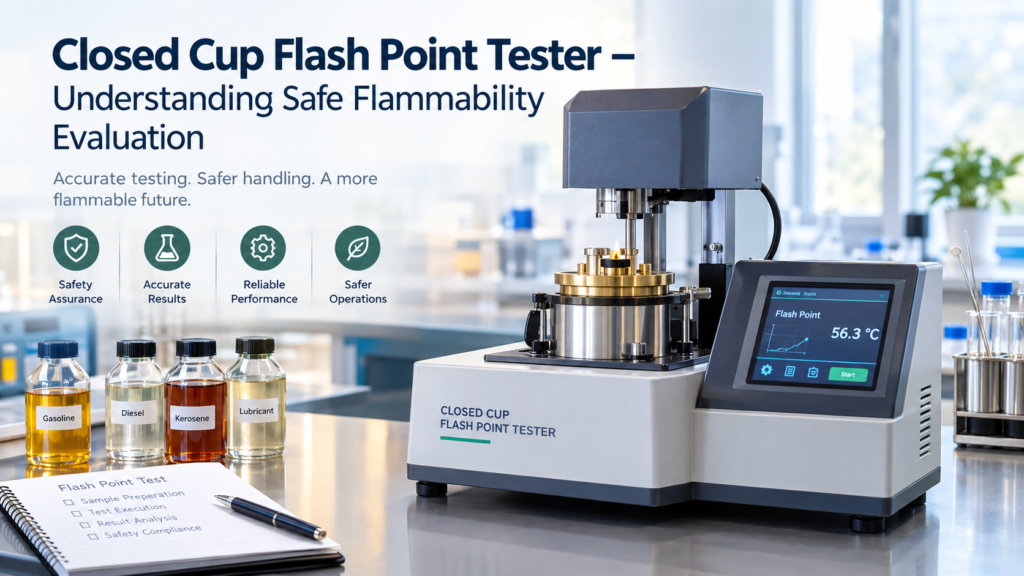
Determining the flammability characteristics of liquids is an important responsibility in chemical laboratories, industrial facilities, and petroleum testing environments. Many liquids release vapors that can ignite when exposed to an ignition source under suitable conditions. A closed cup flash point tester helps determine the temperature at which a liquid produces sufficient vapor to flash under specified testing conditions.
Understanding Flash Point Testing
Flash point is the lowest test temperature, corrected as required by the applicable method, at which a liquid produces enough vapor to ignite momentarily when an ignition source is introduced.
This measurement provides useful information about flammability hazards.
However, flash point does not represent the temperature at which a liquid necessarily burns continuously.
Why Closed Cup Testing Is Different
Closed cup methods use a covered sample container that limits vapor exchange with the surrounding environment.
This configuration allows vapors to accumulate in the space above the liquid during testing.
Because vapor behavior differs between open and closed containers, open cup and closed cup results should not automatically be treated as interchangeable.
How a Closed Cup Flash Point Tester Works
The testing process follows a controlled sequence defined by the selected method.
A measured quantity of liquid is introduced into the designated test cup.
The sample is then heated according to the prescribed temperature program.
At specified intervals or under automated control, an ignition source is applied to the vapor space.
The technician or detection system identifies the temperature at which a flash occurs.
Key Components
Typical systems include a sample cup, heating arrangement, temperature measurement device, ignition mechanism, and control components.
Certain methods also require sample stirring.
Each component contributes to the reliability of the measurement.
Why Flash Point Measurements Matter
Flash point information supports several laboratory and industrial activities.
Hazard Assessment
Flammability data helps personnel recognize the potential ignition hazards associated with liquids.
This information contributes to risk assessments and the development of appropriate handling procedures.
Material Classification
Flash point is one of the properties considered in various chemical classification and transportation frameworks.
The applicable classification rules must be consulted because flash point alone may not determine every regulatory requirement.
Quality Evaluation
Unexpected changes in flash point can indicate differences in material composition or possible contamination.
Laboratories may use testing to investigate whether a sample behaves consistently with its expected characteristics.
Important Testing Variables
Accurate measurements require attention to multiple operating conditions.
Heating Rate
Excessively rapid or inconsistent heating can affect the temperature at which ignition is detected.
Following the prescribed heating program is therefore essential.
Sample Preparation
Contamination, moisture, and loss of volatile components can influence test results.
Samples should be collected, stored, and handled according to the applicable procedure.
Atmospheric Pressure
Atmospheric pressure can influence measured flash point.
Some test methods specify corrections or reporting requirements related to pressure.
Choosing the Appropriate Method
A closed cup flash point tester must be compatible with the intended test procedure and sample type.
Different methods may use distinct heating rates, ignition arrangements, sample volumes, and operating ranges.
For example, certain petroleum products are evaluated using established closed cup procedures designed for their physical characteristics.
Selecting an unsuitable method may produce results that are difficult to interpret or compare.
Manual and Automated Testing
Manual systems require greater operator involvement during heating and flash detection.
Automated systems can manage selected testing operations and record measurements with reduced manual intervention.
Both approaches require correct preparation, verification, and adherence to the relevant method.
Safe Laboratory Practices
Flash point testing intentionally brings potentially flammable vapors into contact with an ignition source.
Appropriate ventilation, protective equipment, and instrument operating procedures are essential.
Operators should inspect equipment before testing and avoid exceeding the permitted sample or temperature limits.
Conclusion
A closed cup flash point tester plays an important role in evaluating the flammability characteristics of liquid materials. Reliable results depend on proper sample handling, suitable test methods, controlled heating, and careful equipment maintenance. Understanding these requirements helps laboratories produce meaningful measurements while supporting safer chemical handling and quality assessment.