Fascisterne: Meaning, History, Ideology and Key Facts
Discover what fascisterne means, explore the history of fascism in Europe, understand its defining beliefs, and learn why it remains relevant today
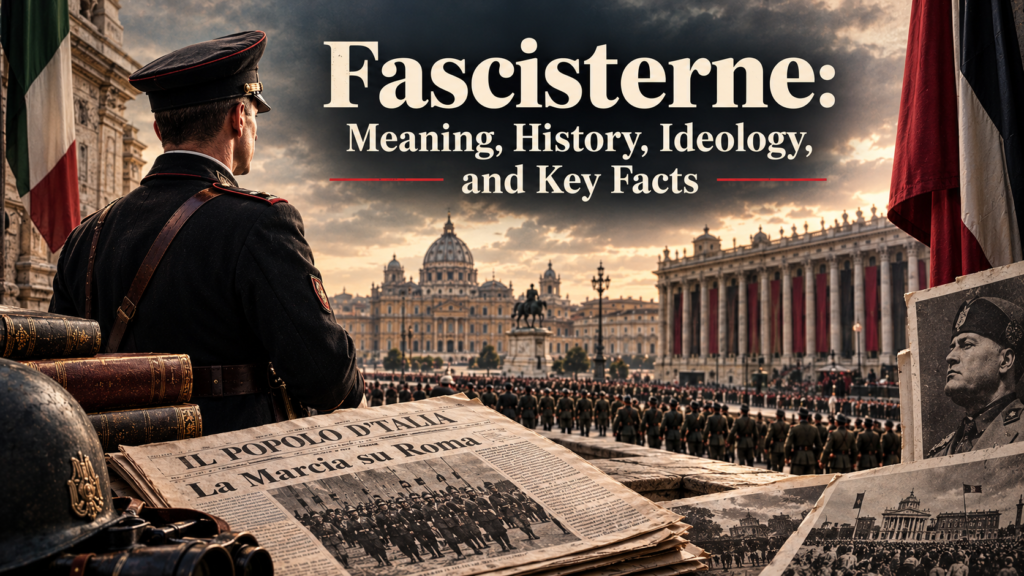
Fascisterne: Meaning, History, Ideology, and Modern Relevance
The term fascisterne is a Danish word that translates into English as “the fascists.” It refers to people who support or belong to fascist political movements, an ideology historically associated with authoritarian leadership, extreme nationalism, political repression, and the rejection of democratic principles. The word is closely connected to some of the most consequential political developments of the twentieth century, particularly the rise of fascism in Italy and Nazi Germany.
Understanding fascisterne requires more than examining a political label. It involves exploring the historical circumstances that allowed fascist movements to emerge, the beliefs that shaped their supporters, and the methods they used to gain and maintain power. The subject remains relevant because debates about nationalism, political extremism, democratic institutions, and civil liberties continue to influence societies around the world.
This article explores the meaning of fascisterne, its historical origins, defining characteristics, relationship with European politics, and continuing importance in contemporary discussions.
What Does Fascisterne Mean?
Fascisterne is the definite plural form of the Danish word “fascist.” In ordinary English, its closest equivalent is “the fascists.” The term describes multiple people who support fascism, participate in fascist organizations, or promote political systems based on fascist principles.
The word is derived from “fascism,” a political ideology that developed in Europe during the early twentieth century. Fascism generally promotes authoritarian government, aggressive nationalism, centralized political power, and the subordination of individual freedoms to the interests of a supposedly unified nation.
The meaning of fascisterne depends on the context in which it appears. In historical writing, it may describe members of established fascist movements. In political discussion, it may refer to individuals who advocate similar authoritarian ideas. In everyday language, the term is sometimes used as an insult, although this broader usage can obscure its historical meaning.
A careful understanding of fascisterne therefore requires distinguishing between historically documented fascist movements and political groups that merely hold nationalist or conservative positions.
Historical Background of Fascisterne
Fascism emerged in a period marked by war, economic instability, social conflict, and dissatisfaction with established political institutions. Its development was especially significant after the First World War, which ended in 1918.
Also read: Merfez: Meaning, Features, Safety, and Online Guide
Millions of people had experienced military service, economic hardship, and the destruction caused by industrial warfare. Several European countries faced unemployment, political polarization, labor unrest, and disputes over the future of their political systems.
These conditions did not automatically produce fascism, but they created opportunities for movements that promised national renewal, strong leadership, and decisive action.
The Rise of Fascism in Italy
Italy became the birthplace of the first major fascist movement under Benito Mussolini. In 1919, Mussolini established the Fasci Italiani di Combattimento, an organization that helped develop the political movement that became Italian Fascism.
Mussolini presented himself as a leader capable of restoring national pride and overcoming political instability. His movement attracted support from different sections of society, including nationalist activists, some business interests, former soldiers, and people who feared socialist revolution.
In October 1922, the March on Rome helped Mussolini secure appointment as prime minister. He subsequently dismantled democratic institutions and established a dictatorship.
The Italian experience became a defining example of how fascisterne could use political violence, propaganda, public demonstrations, and existing political weaknesses to gain influence.
Fascism in Germany
Germany experienced its own extreme nationalist movement after the First World War. The Nazi Party, led by Adolf Hitler, exploited resentment over Germany’s defeat, the Treaty of Versailles, economic instability, and widespread dissatisfaction with the Weimar Republic.
The Nazi movement shared important characteristics with Italian Fascism, including authoritarian leadership, militarism, aggressive nationalism, and hostility toward political opponents. However, Nazism also placed a central emphasis on racist ideology, antisemitism, and the supposed superiority of an imagined racial community.
Hitler became chancellor in January 1933. His government rapidly destroyed democratic checks and balances, established a totalitarian dictatorship, and persecuted political opponents and targeted communities.
Nazi rule led to the Holocaust, in which six million Jews were murdered, alongside the persecution and mass murder of millions of other victims. Nazi Germany also played a central role in initiating the Second World War in Europe.
The history of fascisterne in Germany demonstrates the devastating consequences of combining authoritarian government with systematic racism, state violence, and the elimination of democratic accountability.
Biography Table: Key Historical Figures Associated With Fascism
The following table provides basic historical information about two major figures associated with twentieth-century fascist movements.
| Category | Benito Mussolini | Adolf Hitler |
|---|---|---|
| Full name | Benito Amilcare Andrea Mussolini | Adolf Hitler |
| Born | July 29, 1883 | April 20, 1889 |
| Birthplace | Predappio, Italy | Braunau am Inn, Austria-Hungary |
| Nationality | Italian | Austrian-born German |
| Political movement | Italian Fascism | Nazism |
| Major leadership role | Prime minister and dictator of Italy | Chancellor and dictator of Germany |
| Death | April 28, 1945 | April 30, 1945 |
These individuals played different roles in the development of European fascism, but both contributed to the destruction of democratic government and the expansion of political repression. Their historical records are essential to understanding the ideology and consequences associated with fascisterne.
Core Characteristics of Fascisterne
Fascist movements have not all been identical. Nevertheless, historians and political scholars identify several recurring characteristics that help explain how fascism operates.
1. Authoritarian Leadership
Fascism typically concentrates political authority in a dominant leader or ruling party. Such leaders often present themselves as the only people capable of protecting the nation from internal and external threats.
Opposition parties, independent courts, and legislative institutions may be portrayed as obstacles to national unity. Once fascist movements acquire power, they frequently weaken or eliminate these institutions.
For fascisterne, loyalty to the leader can become more important than constitutional rules, independent judgment, or democratic accountability.
2. Extreme Nationalism
Nationalism is another central feature of fascism, although nationalism itself is not necessarily fascist. Many democratic societies maintain strong national identities without rejecting political freedom or equal rights.
Fascist nationalism differs because it often portrays the nation as a threatened community that must be restored through discipline, exclusion, and unquestioning loyalty.
Fascist rhetoric frequently divides society into supposedly authentic members of the nation and groups portrayed as dangerous outsiders. These divisions can encourage discrimination, political hostility, and persecution.
3. Political Violence and Intimidation
Historical fascist movements often used organized violence against opponents. Paramilitary groups, street confrontations, intimidation campaigns, and attacks on political organizations helped them weaken resistance.
In Italy, Fascist squads known as the Blackshirts attacked socialists, trade unionists, and other opponents. In Germany, Nazi paramilitary organizations helped intimidate political rivals and create an atmosphere of fear.
Violence was not simply an accidental feature of these movements. In many cases, it formed part of a broader strategy to undermine pluralism and establish political dominance.
4. Propaganda and Political Control
Fascist governments placed considerable importance on controlling public narratives. They used newspapers, radio, public ceremonies, posters, films, and carefully staged rallies to promote their ideology.
Propaganda presented the ruling movement as the embodiment of national interests while depicting opponents as traitors, enemies, or threats to public order.
Independent journalism and criticism were often restricted. Governments also attempted to influence education and cultural institutions so that younger generations would accept the official political worldview.
The history of fascisterne illustrates how communication systems can be used to manipulate public opinion when independent institutions are weakened.
5. Suppression of Individual Freedom
Fascist political systems generally subordinate individual rights to the interests defined by the state or ruling movement.
Freedom of speech, freedom of association, political participation, and independent labor organization may be severely restricted. People who criticize the government can face surveillance, dismissal, imprisonment, or physical violence.
Such policies reduce the ability of citizens to challenge abuses of power. They also make it harder for independent organizations to defend vulnerable communities.
Fascisterne and Democratic Institutions
Democracy depends on more than elections. It also requires the rule of law, political competition, independent institutions, freedom of expression, and protections for minority rights.
Fascist movements challenge these principles when they claim that only one political organization can legitimately represent the nation.
A movement may initially participate in elections while simultaneously attacking the legitimacy of opponents or undermining public confidence in democratic procedures. If it later gains sufficient power, it may restrict competition and make peaceful political change increasingly difficult.
This distinction is important when discussing fascisterne in modern political debate. Strong national identity, strict immigration policies, or conservative social values do not automatically establish that a movement is fascist. A more careful assessment considers its attitude toward political violence, pluralism, democratic accountability, and the rights of groups it opposes.
Historical comparisons should therefore be based on specific evidence rather than political disagreement alone.
The Role of Fascisterne in the Second World War
The Second World War represents the most destructive historical chapter associated with major fascist regimes.
Nazi Germany invaded Poland on September 1, 1939, prompting Britain and France to declare war on Germany. The conflict subsequently expanded across Europe, North Africa, Asia, and the Pacific.
Fascist Italy entered the war in June 1940 as an ally of Germany. Both regimes pursued expansionist policies that caused widespread destruction, displacement, and loss of life.
Nazi Germany’s persecution of Jews developed into the Holocaust, a systematic campaign of genocide. Other victims included Roma people, disabled people, Soviet prisoners of war, Polish civilians, political opponents, and additional groups targeted by Nazi persecution.
The war also exposed the consequences of militarism and the concentration of political power without meaningful public accountability.
By 1945, both Mussolini’s regime and Hitler’s dictatorship had collapsed. Their defeat discredited the major fascist regimes, although far-right authoritarian movements did not disappear entirely.
Understanding this period is essential to any serious discussion of fascisterne because it connects political ideology with its real historical consequences.
Fascisterne in the Postwar Period
Following the Second World War, European societies confronted the destruction caused by fascist and Nazi rule. War-crimes trials, denazification efforts, constitutional reforms, and public education sought to address the crimes of the defeated regimes.
Germany developed institutions designed to protect democratic government and prevent the return of Nazi dictatorship. Italy also became a democratic republic after the monarchy was rejected in a 1946 referendum.
However, fascist ideas and far-right political organizations continued to exist in various forms. Some groups openly preserved elements of historical fascism, while others adopted new political language and organizational methods.
In the postwar period, fascisterne became a subject of continuing historical research, political debate, and public remembrance. Museums, memorials, educational programs, and commemorative events have helped preserve evidence of the victims and consequences of fascist rule.
These efforts are intended not only to remember the past but also to strengthen public understanding of democratic responsibility.
Fascisterne in Contemporary Political Discussion
Today, the term fascisterne appears in discussions about political extremism, nationalism, authoritarianism, and democratic decline. Its use can be informative when it accurately describes a movement’s ideology or historical connections. It can also become misleading when used without clear evidence.
Modern political movements operate in circumstances that differ significantly from those of interwar Europe. They may use digital platforms, online communities, and contemporary communication techniques instead of the mass organizations and traditional propaganda systems associated with early fascism.
Researchers examining potential similarities often consider several questions:
- Does the movement reject legitimate political opposition?
- Does it encourage or excuse political violence?
- Does it seek to concentrate power and weaken independent institutions?
- Does it promote exclusionary ideas about national identity?
- Does it attempt to restrict press freedom or undermine democratic accountability?
No single characteristic necessarily proves that a movement is fascist. A meaningful assessment considers the combination of ideological beliefs, political behavior, organizational methods, and historical context.
This approach makes discussions of fascisterne more precise and reduces the risk of treating a complex historical term as a general insult.
How Fascism Differs From Other Political Ideologies
Fascism is sometimes confused with authoritarianism, communism, conservatism, or nationalism. Although these concepts can overlap in particular historical circumstances, they are not interchangeable.
Authoritarianism describes political systems that concentrate power and restrict meaningful opposition. Fascism is generally authoritarian, but not every authoritarian regime is fascist.
Nationalism emphasizes national identity and sovereignty. Democratic national movements can support constitutional government and equal citizenship, whereas fascist nationalism typically emphasizes hierarchy, enforced unity, and exclusion.
Conservatism encompasses diverse political traditions that often value continuity, established institutions, or gradual change. Conservatism does not inherently require dictatorship or political violence.
Communism is associated with political and economic traditions seeking a classless society and collective ownership of productive resources. Historical communist regimes have sometimes been authoritarian, but communism and fascism developed from different ideological foundations and often treated each other as enemies.
These distinctions help explain why fascisterne should be understood through a clear historical and political framework rather than through superficial similarities.
Why Studying Fascisterne Matters
Studying fascism provides valuable lessons about the vulnerability of democratic institutions and the consequences of political dehumanization.
First, it shows how crises can create opportunities for leaders who promise simple solutions to complex problems. Economic hardship, public insecurity, and distrust of established institutions can make authoritarian promises attractive to some citizens.
Also read: Wollmatten Guide: Types, Benefits, Uses and Buying Tips
Second, the historical record demonstrates the importance of independent journalism, judicial independence, civic organizations, and peaceful political competition. These institutions create opportunities to challenge government decisions and expose abuses.
Third, the history of fascisterne highlights the dangers of portraying entire communities as enemies. When political rhetoric strips people of their dignity or presents them as threats solely because of their identity, discrimination and persecution can become easier to justify.
Finally, historical understanding encourages responsible political discussion. Recognizing the specific features of fascism allows citizens to identify genuine authoritarian dangers without reducing every political disagreement to a comparison with twentieth-century dictatorships.
Frequently Asked Questions About Fascisterne
1. What does fascisterne mean in English?
Fascisterne is a Danish word meaning “the fascists.” It refers to people who support fascism or belong to fascist political movements.
2. Is fascisterne a Danish word?
Yes. Fascisterne is the Danish definite plural form of “fascist.” Its meaning is connected to the broader European history of fascist political movements.
3. Who were the most famous fascist leaders?
Benito Mussolini of Italy and Adolf Hitler of Nazi Germany are two of the most prominent historical figures associated with fascism. Their regimes destroyed democratic institutions, persecuted opponents, and contributed to the devastation of the Second World War.
4. What are the main beliefs associated with fascisterne?
Fascist movements commonly emphasize authoritarian leadership, extreme nationalism, political unity enforced from above, hostility toward liberal democracy, and the suppression of political opposition. Specific movements may also promote racial or ethnic supremacy.
5. How did fascism become powerful in Europe?
Fascism gained support amid the aftermath of the First World War, economic instability, political conflict, fear of revolution, and dissatisfaction with existing governments. Leaders exploited these conditions through propaganda, organized violence, and promises of national renewal.
6. Are fascism and nationalism the same?
No. Nationalism can exist within democratic political systems. Fascism uses an extreme and often exclusionary form of nationalism that is typically combined with authoritarian leadership, political repression, and hostility toward democratic pluralism.
7. Does fascism still exist today?
Fascist and neo-fascist organizations continue to exist in some countries, although their influence and characteristics vary. Researchers distinguish these groups from other political movements by examining their ideology, historical connections, organizational practices, and attitudes toward democracy.
8. Why is fascisterne relevant today?
The term remains relevant because societies continue to debate authoritarian leadership, political extremism, propaganda, civil liberties, and democratic stability. Studying historical fascism helps people evaluate these issues with greater accuracy.
9. What happened to fascist regimes after the Second World War?
The major fascist regimes in Italy and Germany collapsed in 1945. Their defeat was followed by criminal trials, political reforms, and efforts to document their crimes. However, some far-right and neo-fascist movements survived or later emerged in different forms.
10. How can historians identify a fascist movement?
Historians examine a movement’s political ideology, leadership structure, nationalism, use of violence, treatment of opponents, and relationship with democratic institutions. They also consider historical context rather than relying on a single characteristic.
A Historical Perspective Worth Preserving
The history of fascisterne is ultimately a study of how political movements can transform social frustration into authoritarian power. The experiences of Italy and Germany demonstrate that democratic systems can become vulnerable when political violence is normalized, independent institutions are weakened, and national identity is used to justify the exclusion of entire communities.
Understanding these developments requires careful historical research, clear terminology, and a willingness to distinguish documented facts from political rhetoric. The legacy of fascism remains important not because every contemporary political conflict resembles the past, but because the historical record provides essential context for evaluating threats to freedom, equality, and democratic government